
Molecular Hydrogen PPM & Dose Calculators
Use the H2HUBB hydrogen water calculators to convert dissolved H₂ concentration into total milligrams, convert ounces to liters, estimate how much hydrogen-rich water corresponds to a user-selected H₂ amount, and convert hydrogen inhalation output from mL/min to mg/min.
Understand What Each Number Means
A hydrogen concentration and a hydrogen amount are not the same measurement. These calculators help separate concentration, water volume, total dissolved H₂, and gas-flow output so product results can be compared more accurately.
mg/L or ppm
Describes how much dissolved H₂ is present per liter of water. It is a concentration, not the total amount in the container.
Liters of Water
The same H₂ concentration produces a different total H₂ amount in a 200 mL bottle than in a 500 mL bottle.
Milligrams
Multiplying concentration by water volume gives the approximate total dissolved H₂ in the measured serving.
mL/min vs. mg/min
Inhalation devices are often described by volumetric H₂ flow. Converting to mass flow provides another way to express gas output under defined reference conditions.
Hydrogen Water & Inhalation Calculators
Enter your own measured values into the tools below. The calculators preserve H2HUBB's existing calculation logic and are intended for measurement and educational use—not individualized medical dosing.
How Many Milligrams of H₂ Did I Drink?
Enter the measured dissolved-H₂ concentration and the water volume to calculate the approximate total milligrams of molecular hydrogen in that serving.
mg H₂ = mg/L × liters
Convert Fluid Ounces to Liters
Convert a water serving from U.S. fluid ounces to liters before using the hydrogen-dose calculator.
1 U.S. fl oz ≈ 0.0295735 L
How Much Hydrogen Water Corresponds to My H₂ Target?
Enter a measured dissolved-H₂ concentration and a user-selected milligram amount to estimate the volume of hydrogen-rich water that contains that amount of H₂.
liters = target mg H₂ ÷ mg/L
Hydrogen Inhalation mL/min to mg/min
Convert molecular-hydrogen gas output from milliliters per minute to milligrams per minute using the reference conditions configured in the H2HUBB calculator.
Source-gas mass flow is not the same as the H₂ concentration actually inspired by a person.
Why Concentration Alone Can Be Misleading
A high mg/L number can be impressive, but it should be interpreted together with serving volume, test method, cycle time, sampling time, and repeatability.
5.0 mg/L in 200 mL
5.0 mg/L × 0.200 L = approximately 1.0 mg of dissolved H₂ in the full serving.
5.0 mg/L in 500 mL
The same concentration in 0.500 L contains approximately 2.5 mg of dissolved H₂.
Average vs. Peak
An average from repeated tests is generally more useful for expected performance than a single highest reading.
H₂ Can Escape
Dissolved hydrogen can be lost after opening or generation, so sampling and drinking time should be considered.
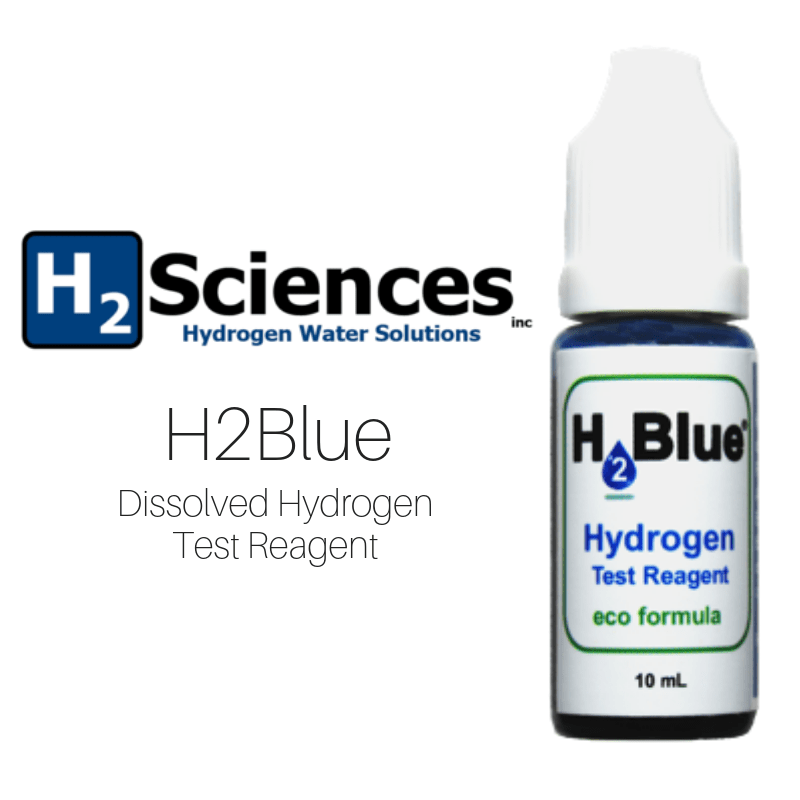
H₂Blue Dissolved Hydrogen Test Reagent
H₂Blue is a titration reagent used to estimate dissolved molecular hydrogen concentration in hydrogen-rich water. The current H2HUBB product listing states that, when used with the specified 6 mL sample method, each drop corresponds to 0.1 mg/L (ppm) of dissolved H₂.
H2HUBB has also compared H₂Blue results against known hydrogen standards and other analytical methods. As with any titration technique, careful sample volume, temperature, timing, drop counting, and user technique matter.
- 01Use the correct sample volume specified for the reagent.
- 02Test promptly to reduce H₂ loss before measurement.
- 03Use the measured mg/L value with the calculators above.
- 04For product comparisons, prefer repeated measurements and clearly documented procedures.
Connect H₂ Measurements to Products & Research
Calculators can translate units, but they do not determine whether a product performs consistently or whether a particular H₂ exposure produces a health outcome. Use H2HUBB's independent product pages for measured performance and the Research Library for the underlying scientific evidence.