AquaCure AC50 Review, Test Results & Discount
Product Review & Independent Test Results
Review the product overview, H2HUBB testing information, measured performance when available, pricing, specifications, and buying guidance.
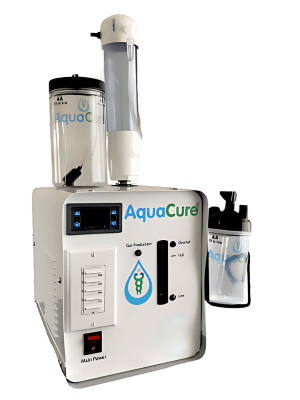
This AquaCure AC50 review covers the AquaCure AC50, an adjustable Brown’s gas generator and oxyhydrogen generator manufactured by Eagle Research. This page includes independent H2HUBB test results, estimated inhaled-H₂ concentrations, specifications, safety information, current pricing, and the available AquaCure AC50 discount.
Independent H2HUBB testing measured approximately 409.1 mL/min of molecular hydrogen at the recommended 40% output setting. At maximum output, the AC50 averaged approximately 1,003 mL/min of total oxyhydrogen gas, including approximately 662 mL/min of hydrogen. The report’s final standardized maximum result was approximately 640.55 mL/min of H₂ at SATP.
AquaCure AC50 Brown’s Gas Generator Review & Test Results
AquaCure AC50 Review & Test Results
The AquaCure AC50 is an adjustable Brown’s gas generator manufactured by Eagle Research. It uses alkaline water electrolysis to generate a premixed oxyhydrogen gas composed of approximately two parts molecular hydrogen and one part oxygen by volume.
Unlike a pure-hydrogen PEM/SPE system, the AquaCure produces hydrogen and oxygen together without membrane separation. This mixture is commonly described as Brown’s Gas, HydrOxy, HHO, or oxyhydrogen.
Independent H2HUBB testing evaluated the AC50 at both the recommended 40% inhalation setting and its maximum output. Testing was conducted for approximately 60 minutes using gas-displacement measurements converted to SATP.
Brown’s Gas Generator Performance at 40% Output
At the manufacturer-recommended 40% inhalation setting, the AquaCure produced an average of approximately 620 mL/min of total oxyhydrogen gas.
Based on the measured gas composition, this included approximately 409.1 mL/min of molecular hydrogen, equivalent to approximately 33.7 mg of H₂ per minute. Individual measurements ranged from approximately 401.2–422.4 mL/min of hydrogen.
Using the current H2HUBB inhaled-H₂ concentration model, the 409.1 mL/min hydrogen component corresponds to approximately 1.82–2.10% estimated inhaled H₂ for one adult at a resting minute ventilation of 6.5–7.5 L/min.
VE, or minute ventilation, is the total amount of air breathed each minute. H2HUBB’s model applies approximately 20 seconds of active inhalation per minute during nasal-cannula use, resulting in approximately 136.37 mL of effective inhalation-phase hydrogen per minute.
Oxyhydrogen Generator Maximum-Output Results
At maximum output, the AC50 produced an average of approximately 1,003 mL/min of total oxyhydrogen gas. The hydrogen component averaged approximately 662.0 mL/min, or approximately 54.6 mg/min.
H2HUBB’s final standardized maximum result was approximately 640.55 mL/min of H₂ at SATP, equivalent to approximately 52.81 mg/min.
Under the H2HUBB inhalation model, the standardized 640.55 mL/min hydrogen output would correspond to approximately 2.85–3.28% estimated inhaled H₂ at 6.5–7.5 L/min resting ventilation.
Maximum output represents the device’s production capacity and should not automatically be interpreted as the proper setting for inhalation. The 2019 H2HUBB report identified the 40% setting as the recommended inhalation level.
Actual inhaled concentration varies with output selection, minute ventilation, breathing pattern, cannula fit, tubing configuration, mouth breathing, gas leakage, and the manufacturer’s current operating protocol.
Adjustable AquaCure AC50 Output
One of the AC50’s primary operating features is electronically adjustable gas production. This allows users to reduce the total gas flow for inhalation while retaining higher production capacity for manufacturer-approved non-inhalation applications.
Eagle Research currently rates the system at up to approximately 50 liters per hour, or about 833 mL/min, of Brown’s Gas. Differences between this manufacturer rating and H2HUBB’s measured maximum may reflect test conditions, conversion methods, machine settings, electrolyte condition, temperature, elevation, or product revisions.
The current AC50 includes a digital output display, adjustable gas controls, electronic timer, continuous-operation mode, and an hour meter used to track maintenance intervals.
Test Configuration and Current Electrolyte Instructions
The H2HUBB summary report evaluated model AC50-B, serial number FE120-1906-016, in 2019. Testing used a 1.2-liter reservoir and sodium hydroxide electrolyte prepared at approximately 150 g/L, or 4M.
Eagle Research’s current product information describes a different approximate electrolyte preparation of 80 grams of sodium hydroxide per liter. Users should follow the current operation manual supplied by Eagle Research rather than relying on the historical H2HUBB test concentration.
Sodium hydroxide is caustic. It must be handled with appropriate gloves, eye protection, containers, filling procedures, and storage precautions. Never improvise electrolyte concentrations or maintenance procedures.
AquaCure AC50 Safety Assessment
Brown’s Gas is a premixed hydrogen-and-oxygen gas. Because the hydrogen and oxygen are generated together in a combustible ratio, the mixture can ignite or detonate when exposed to a flame, spark, hot surface, static discharge, improper pressure, or other ignition source.
The gas should be generated only as needed and should never be deliberately stored, compressed, confined, or collected inside a sealed container. Users must keep all gas tubing clear and unobstructed.
Eagle Research currently lists low- and high-liquid-level shutoffs, approximately 2 psi electrical overpressure protection, approximately 3 psi mechanical pressure relief, anti-backfill protection, full power-and-neutral shutoff, adjustable gas production, a Tower Cap pre-scrubber, and a separate humidifier used to reduce potential electrolyte carryover.
H2HUBB approval does not mean that an electrolyte-based oxyhydrogen generator is risk-free. Approval means the evaluated system met H2HUBB’s applicable performance threshold and demonstrated the reported hydrogen output under the stated test conditions.
Based on its independently verified hydrogen output and adjustable operating design, the AquaCure AC50 received the H2HUBB Seal of Approval.
Learn more in the H2HUBB Hydrogen Inhalation Therapy Guide and review the H2HUBB Product Performance Standards.
AquaCure AC50 Discount
Shop through the H2HUBB hydrogen marketplace and use code H2HUBB5 to receive the current AquaCure AC50 discount.
The standard 120 V and 240 V models are currently listed at $2,699 and are reduced to approximately $2,564.05 after the 5% discount. The switchable AC50V2 is currently listed at $2,999 and is reduced to approximately $2,849.05.
About Eagle Research
Eagle Research develops Brown’s Gas generators, electrolyzers, fuel-enhancement technologies, educational resources, and related equipment. The company identifies George Wiseman as the developer of the AquaCure and states that its electrolyzer experience extends back more than four decades.
Eagle Research states that AquaCure manufacturing is conducted in the United States and Canada. The AC50 is designed as an adjustable Brown’s gas generator for on-demand oxyhydrogen production.
Additional current product information is available through the official Eagle Research AquaCure AC50 page.
Independent H2HUBB Evaluation
H2HUBB evaluated the AquaCure AC50-B between June 22 and August 13, 2019. The testing measured output at the 40% recommended inhalation setting and the maximum 100% setting.
At 40% output, the unit averaged approximately 409.1 mL/min of hydrogen. At maximum output, the unit averaged approximately 662.0 mL/min of hydrogen, with a final standardized maximum result of approximately 640.55 mL/min at SATP.
Shop Through H2HUBB
Shop the AquaCure AC50 through H2HUBB to access independent hydrogen-output testing, inhaled-H₂ estimates, specifications, safety disclosures, current pricing, the official H2HUBB test report, and available marketplace savings.
Current Pricing
Standard 120 V or 240 V AC50: $2,699
H2HUBB Discounted Standard Price: $2,564.05 with code H2HUBB5
Switchable 120/240 V AC50V2: $2,999
H2HUBB Discounted AC50V2 Price: $2,849.05 with code H2HUBB5
Warranty and Satisfaction Guarantee
Eagle Research currently lists a lifetime manufacturer’s warranty for qualifying direct purchases. The stated coverage includes manufacturer-related parts, labor, and shipping, subject to current eligibility requirements and exclusions.
The manufacturer also lists a one-year satisfaction guarantee for a purchaser’s first AquaCure. Current terms include return authorization, inspection, a $200 restocking fee, and exclusions for shipping, taxes, duties, and customer-related damage.
Warranty and satisfaction-guarantee privileges are tied to qualifying purchases through Eagle Research. Buyers should review the current written policies before placing an order.
AquaCure AC50 Discount & Current Offer
Use code H2HUBB5 through the H2HUBB marketplace link for 5% off the current AquaCure AC50 price.
AquaCure AC50 Brown’s Gas Generator Specifications
The AquaCure AC50 is an adjustable alkaline-electrolysis oxyhydrogen generator that produces Brown’s Gas containing approximately 66% hydrogen and 33% oxygen.
H2HUBB-Verified 40% Output Performance
- Tested Output Setting: 40%
- Test Position: Manufacturer-recommended inhalation setting
- Average Total Oxyhydrogen Output: Approximately 620 mL/min
- Average Hydrogen Output: Approximately 409.1 mL/min
- Average Hydrogen Mass: Approximately 33.7 mg/min
- Measured H₂ Range: Approximately 401.2–422.4 mL/min
- Effective Inhalation-Phase H₂: Approximately 136.37 mL/min
- Estimated Inhaled H₂: Approximately 1.82–2.10%
- Resting Minute Ventilation Model: 6.5–7.5 L/min
H2HUBB-Verified Maximum Performance
- Tested Output Setting: 100%
- Average Total Oxyhydrogen Output: Approximately 1,003 mL/min
- Average Hydrogen Component: Approximately 662.0 mL/min
- Average Hydrogen Mass: Approximately 54.6 mg/min
- Measured H₂ Range: Approximately 654.7–670.5 mL/min
- Final Standardized Maximum H₂: Approximately 640.55 mL/min at SATP
- Final Standardized H₂ Mass: Approximately 52.81 mg/min
- Effective Inhalation-Phase H₂: Approximately 213.52 mL/min
- Estimated Maximum FiH₂: Approximately 2.85–3.28%
- H2HUBB Position: Maximum output represents capacity, not the recommended inhalation setting
H2HUBB Test Conditions
- Tested Model: AC50-B
- Serial Number: FE120-1906-016
- Testing Began: June 22, 2019
- Testing Completed: August 13, 2019
- Test Duration: Approximately 60 minutes per flow condition
- Test Elevation: Approximately 909 feet
- Water pH: Approximately 6.0
- Water Temperature: Approximately 61–66°F or 16.1–18.8°C
- Test Reservoir Capacity: Approximately 1.2 liters
- 2019 Test Electrolyte: Sodium hydroxide at approximately 150 g/L or 4M
- Test Method: Gas displacement with results normalized to SATP
- H2HUBB Status: H2HUBB Seal of Approval
Current Manufacturer-Listed Performance
- Maximum Brown’s Gas Output: Up to approximately 50 liters per hour
- Approximate Maximum Total Flow: 833 mL/min
- Gas Composition: Approximately 66% H₂ and 33% O₂
- Gas Adjustment: Electronic user-adjustable output
- Timer: Electronic timer with timed and continuous settings
- Hour Meter: Included for maintenance tracking
- Continuous Operation: Manufacturer states the system is designed for extended continuous use
- Recommended Maintenance Rinse: Approximately every 100 operating hours
Electrical and Physical Specifications
- Power Consumption: Approximately 240–250 W at full output
- 120 V Current: Approximately 2 A
- 240 V Current: Approximately 1 A
- Voltage Options: 120 V, 240 V, or switchable 120/240 V AC50V2
- Operating Dimensions: Approximately 12 × 12 × 9 inches, excluding the Tower Cap
- Operating Weight: Approximately 16 lb
- Shipping Box: Approximately 18 × 16 × 14 inches
- Shipping Weight: Approximately 26 lb
- Manufacturing: Manufacturer states USA and Canada
Electrolyte and Water Requirements
- Electrolyte: Sodium hydroxide or lye
- Current Manufacturer Approximation: Approximately 80 grams per liter
- Historical H2HUBB Test Concentration: Approximately 150 g/L or 4M
- Operating Water: Pure distilled water
- Water Testing: Manufacturer currently includes a TDS meter
- Maintenance Requirement: Follow the current AquaCure manual and online resources
Manufacturer-Listed Safety Systems
- Low-liquid-level alarm and automatic shutoff
- High-liquid-level automatic shutoff
- Approximately 2 psi electrical overpressure shutoff
- Approximately 3 psi mechanical pressure relief
- Anti-backfill check-valve system
- Full power-and-neutral master shutoff
- Electronically adjustable gas production
- Tower Cap pre-scrubber
- Separate humidifier or electrolyte-mist scrubber
- Low-pressure on-demand gas production
- Cooling and temperature-management design
These safety mechanisms are currently listed by Eagle Research. The uploaded H2HUBB document is a summary performance report and does not contain the complete safety-testing section.
Current Manufacturer-Listed Accessories
- Tower Cap with check valve
- Humidifier and mounting bracket
- One-liter water bubbler
- Bubbling stone
- Nasal cannula and connection tubing
- Soft silicone spot applicator
- Tee connection kit
- Water-filling syringe and funnel
- Safety goggles and nitrile gloves
- TDS meter
- Micro-torch kit
- Online manuals, videos, updates, and product resources
Product Benefits
AquaCure AC50 Brown’s Gas Generator Benefits
- Independently measured hydrogen output:
H2HUBB measured approximately 409.1 mL/min of H₂ at the recommended 40% setting. - Verified maximum production capacity:
The final standardized maximum result was approximately 640.55 mL/min of hydrogen at SATP. - Adjustable gas output:
Electronic controls allow the total Brown’s Gas production rate to be increased or reduced. - Documented inhalation estimate:
The 40% setting corresponds to approximately 1.82–2.10% estimated inhaled hydrogen under the stated adult breathing model. - Multiple operational functions:
The manufacturer supplies accessories for inhalation, water bubbling, external gas application, and micro-torch operation. - Continuous-use capability:
Eagle Research states that the system is designed for extended operation without routine cooling periods. - Electronic timer and hour meter:
These controls support timed sessions and maintenance tracking. - Multiple redundant pressure controls:
The manufacturer lists electrical shutoff and mechanical pressure relief at comparatively low pressures. - Liquid-level protection:
The system monitors both low and excessive electrolyte levels. - Gas-path protection:
Anti-backfill, Tower Cap, humidifier, and pressure-management components help control gas and moisture movement. - Long-term manufacturer support:
Qualifying direct purchases include a manufacturer-listed lifetime warranty and one-year satisfaction guarantee. - Independent marketplace approval:
The AquaCure AC50 received the H2HUBB Seal of Approval. - Exclusive marketplace savings:
Code H2HUBB5 provides 5% off the current manufacturer price.
Ideal For
Who the AquaCure AC50 Is Ideal For
- Users specifically seeking an adjustable Brown’s gas generator
rather than a pure-hydrogen PEM/SPE system. - Customers comparing oxyhydrogen generators
who want independent H2HUBB flow measurements. - Users seeking approximately 409 mL/min of measured H₂
at the evaluated 40% output setting. - Users targeting approximately 1.82–2.10% estimated inhaled H₂
under the stated adult resting-ventilation model. - Customers who want adjustable output
instead of a single fixed gas-production rate. - Users interested in both gas and water-bubbling functions
through one manufacturer-supplied system. - Buyers who value extended-operation capability
with electronic timing and maintenance tracking. - Customers prioritizing multiple manufacturer-listed safeguards
for liquid level, pressure, backfill, gas scrubbing, and electrical shutoff. - Users willing to perform hands-on maintenance
and correctly handle sodium hydroxide electrolyte. - Buyers who will carefully follow operating and safety instructions
for a combustible premixed hydrogen-and-oxygen system. - Shoppers seeking an AquaCure AC50 discount
through the H2HUBB hydrogen marketplace.
The AquaCure is not the best match for buyers wanting a maintenance-minimal pure-H₂ PEM generator. It requires distilled water, sodium hydroxide electrolyte, routine rinsing, gas-path inspection, and strict adherence to Brown’s Gas safety procedures.
Buyers should select the correct 120 V, 240 V, or switchable-voltage model before ordering. The AC50V2 must be manually placed on the correct voltage setting before it is connected to electrical power.
Similar Hydrogen Products
Compare additional products in related H2HUBB marketplace categories.