

H2 Respire 1000 Hydrogen Inhaler Review, Test Results & Discount
Product Review & Independent Test Results
Review the product overview, H2HUBB testing information, measured performance when available, pricing, specifications, and buying guidance.
This H2 Respire 1000 review covers a household-grade hydrogen inhalation machine independently evaluated by H2HUBB. The H2 Respire 1000 hydrogen inhaler provides pure-hydrogen operation, separately generated oxygen, and a manufacturer-configured Brown’s gas inhaler option. This page includes verified flow results, inhaled-H₂ estimates, specifications, safety guidance, hydrogen-water accessory testing, pricing, and the available H2 Respire 1000 discount.
Independent H2HUBB testing using an Alicat Hydrogen Mass Flow Meter measured approximately 660.39 mL/min of molecular hydrogen, 330.19 mL/min of separately produced oxygen, and 990.58 mL/min of total electrolytic gas production at SATP. The measured hydrogen output closely confirmed the manufacturer-rated 666 mL/min specification.
H2 Respire 1000 Review & Independent Test Results
H2 Respire 1000 Hydrogen Inhaler Review & Test Results
The H2 Respire 1000 hydrogen inhaler is a household-grade, mid-flow hydrogen inhalation machine manufactured by Qlife Hydrogen Solutions. It uses PEM/SPE membrane electrolysis to generate hydrogen through dedicated H₂ outlets while oxygen is produced through a separate pathway.
Independent H2HUBB testing using a calibrated Alicat Hydrogen Mass Flow Meter measured approximately 660.39 mL/min of molecular hydrogen, approximately 330.19 mL/min of oxygen, and approximately 990.58 mL/min of total electrolytic gas production at SATP.
The measured hydrogen flow closely confirmed the manufacturer’s 666 mL/min rating. H2HUBB also measured approximately 54.41 mg/min of hydrogen production and calculated an electrolytic-cell efficiency of approximately 98.60%.
Using H2HUBB’s current inhaled-H₂ concentration model, the verified total hydrogen flow corresponds to approximately 2.94–3.39% estimated inhaled H₂ for one adult at a resting minute ventilation of 6.5–7.5 L/min. VE, or minute ventilation, is the total volume of air breathed per minute.
The original report described the single-user concentration as approximately 3–4%. The updated range above uses H2HUBB’s standardized 20-second inhalation model and current 6.5–7.5 L/min adult resting-ventilation range.
Single-User and Multi-User Hydrogen Delivery
The approximately 660.39 mL/min result represents the total hydrogen generated by the system—not 660.39 mL/min from each front connection. When the total flow is divided equally:
- One User: Approximately 2.94–3.39% estimated inhaled H₂
- Two Users: Approximately 1.47–1.69% estimated inhaled H₂ per user
- Three Users: Approximately 0.98–1.13% estimated inhaled H₂ per user
These multi-user estimates assume that the total hydrogen flow is divided evenly. Actual delivery can vary with splitter design, tubing resistance, cannula fit, breathing pattern, mouth breathing, and gas leakage. Single-user operation provides the strongest inhaled-H₂ concentration.
Brown’s Gas Inhaler and Oxyhydrogen Configuration
Qlife also markets the unit as a Brown’s gas inhaler or oxyhydrogen inhalation machine. H2HUBB independently measured hydrogen and oxygen production separately, totaling approximately 990.58 mL/min. Any oxyhydrogen configuration should use only the manufacturer-supplied connection method and operating instructions.
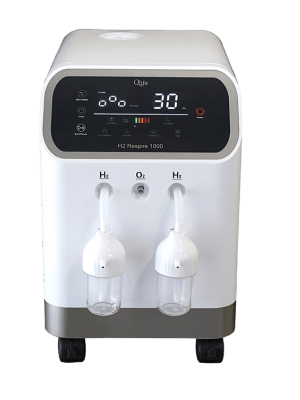
Product images and the current manufacturer listing show two H₂-labeled front outlets and one O₂-labeled outlet. The verified 660.39 mL/min hydrogen result is the total system output shared between the hydrogen outlets.
H2HUBB Safety and Operational Assessment
H2HUBB identified low-water protection, gas-blockage protection, tilt protection, a high-temperature cell sensor, internal cooling fans, heat vents, water-quality monitoring, and an ion-exchange resin filtration system.
Based on its verified output, electrical efficiency, operating controls, safety architecture, and overall performance, the H2 Respire 1000 received the H2HUBB Seal of Approval.
The manufacturer currently publishes both 99.97% and 99.99% hydrogen-purity figures on the same product page. H2HUBB’s evaluation verified hydrogen flow and system performance but did not include independent gas-chromatography purity testing. Public H2HUBB copy should therefore describe the unit as a pure-hydrogen system without presenting an exact purity percentage as independently confirmed.
Supplemental H2 Nano Stick Test
The included H2 Nano Stick can direct hydrogen into drinking water. In supplemental H2HUBB testing, the accessory produced an average dissolved-hydrogen concentration of approximately 1.55 mg/L in 500 mL after ten minutes, corresponding to approximately 0.77 mg of dissolved H₂.
Two 500 mL servings prepared under the same conditions would provide approximately 1.54 mg of dissolved H₂. The Nano Stick result was disclosed for consumer information but was not included as part of the formal inhaler-approval evaluation.
Keep the hydrogen cannulas and all gas-delivery tubing away from flames, smoking materials, sparks, static discharge, heating elements, and every other ignition source. Use only distilled or manufacturer-approved low-TDS water and follow all maintenance instructions.
Learn more about the standards used for this hydrogen inhalation machine in the H2HUBB Product Performance Standards.
Shop through the H2HUBB hydrogen marketplace and use code H2HUBB10 for a 10% H2 Respire 1000 discount—reducing the $3,105 retail price to $2,794.50.
About Qlife Hydrogen Solutions
Qlife Hydrogen Solutions is a molecular-hydrogen equipment brand operated by Micro Research Inc. Its current product range includes hydrogen inhalation machines, hydrogen water bottles and pitchers, bath generators, replacement filters, cannulas, diffusion accessories, and related components.
Qlife’s webshop states that orders are distributed from its warehouse in Taiwan and that Qlife products may also be sold through authorized regional distributors and resellers.
About the H2 Respire 1000
The H2 Respire 1000, model H2R-1000, is a household-grade hydrogen inhalation machine offering pure-hydrogen, separately generated oxygen, and manufacturer-configured oxyhydrogen operation. Although Qlife markets it using “clinical-grade” language, H2HUBB classifies the evaluated unit as a household-grade, mid-flow system.
H2HUBB independently measured approximately 660.39 mL/min of hydrogen and 330.19 mL/min of oxygen. The hydrogen result confirmed the manufacturer’s stated 666 mL/min output within normal testing variation.
Additional manufacturer information is available on Qlife’s official H2 Respire 1000 product page.
Shop Through H2HUBB
Shop the H2 Respire 1000 through H2HUBB to access independent gas-flow testing, updated inhaled-H₂ calculations, specifications, multi-user guidance, safety information, the official test report, and exclusive marketplace savings.
Pricing
Current Retail Price: $3,105
H2HUBB Discount Price: $2,794.50 with code H2HUBB10
Current Savings: $310.50
Warranty, Returns & Availability
Qlife currently lists the H2 Respire 1000 as in stock. Its warranty table provides one year of limited coverage and indicates that repair services and replacement parts are available.
Qlife’s current return policy allows qualifying returns within 30 days, subject to product condition, hygiene, packaging, accessories, shipping expenses, customs charges, and possible restocking fees. Customers should review the complete current terms before ordering.
H2 Respire 1000 Discount & Current Offer
Use code H2HUBB10 for the current H2 Respire 1000 discount. The code reduces the $3,105 retail price by $310.50, resulting in a discounted price of $2,794.50.
Hydrogen Inhalation Machine Specifications
The H2 Respire 1000 is a household-grade, mid-flow hydrogen inhalation machine using a two-cell PEM/SPE electrolytic stack, dedicated hydrogen delivery connections, and separately generated oxygen.
H2HUBB-Verified Gas Performance
- Verified H₂ Output: Approximately 660.39 mL/min at SATP
- Verified H₂ Mass Output: Approximately 54.41 mg/min
- Verified O₂ Output: Approximately 330.19 mL/min
- Total Electrolytic Gas Production: Approximately 990.58 mL/min
- Manufacturer-Rated H₂ Output: 666 mL/min
- Manufacturer-Rated Total Gas Output: Approximately 999–1,000 mL/min
- Manufacturer H₂ Claim Confirmed: Yes
- Measured Electrolytic Efficiency: Approximately 98.60%
- Flow Test Method: Alicat Hydrogen Mass Flow Meter
- Test Duration: One-hour operating session after stabilization
- Results Standardization: SATP
- H2HUBB Status: H2HUBB Seal of Approval
H2HUBB Inhaled-Hydrogen Estimates
- Effective H₂ During Inhalation Phases: Approximately 220.13 mL/min
- One User: Approximately 2.94–3.39% H₂ at 6.5–7.5 L/min VE
- Two Equal Users: Approximately 1.47–1.69% H₂ per user
- Three Equal Users: Approximately 0.98–1.13% H₂ per user
- Original Report Description: Approximately 3–4% for one user
The updated estimates use the current H2HUBB model of approximately 20 seconds of inhalation per minute. Actual concentrations vary with ventilation, breathing pattern, delivery configuration, tubing, cannula fit, and leakage.
PEM Cell and Electrical Performance
- Technology: PEM/SPE membrane electrolysis
- Number of Stacks: One
- Cells per Stack: Two, wired in series
- Total Electrolytic Cells: Two
- Measured Stack Voltage: Approximately 3.8 V DC
- Measured Current: Approximately 44.0 A DC
- Measured Electrical Power: Approximately 167 W
- Measured Voltage per Cell: Approximately 1.91 V
- Effective Electrochemical Current: Approximately 88.0 A
- Consistent Theoretical Maximum H₂ Output: Approximately 669.76 mL/min
- Power-Supply Label: 7 V, 40 A, 280 W
- Manufacturer-Listed System Rating: 300 W, 100–240 V, 50/60 Hz
Page 3 of the H2HUBB report lists a theoretical maximum of approximately 669.76 mL/min, which supports the stated 98.60% efficiency. A separate 1,004.64 mL/min figure on page 4 is inconsistent with the electrical calculation and should not be used on the public product page.
Pure Hydrogen and Brown’s Gas Inhaler Modes
- Pure-Hydrogen Production: Manufacturer rated at 666 mL/min
- Separate Oxygen Production: Manufacturer rated at approximately 333 mL/min
- Brown’s Gas/Oxyhydrogen Configuration: Manufacturer rated at approximately 999–1,000 mL/min total gas
- Front Connections: Two H₂-labeled outlets and one O₂-labeled outlet
- Total H₂ Flow: Shared across hydrogen delivery outlets
H2HUBB measured the hydrogen and oxygen production separately. Follow Qlife’s instructions and use only its approved accessories when configuring oxyhydrogen delivery.
Controls and Operation
- Model: H2R-1000
- Selectable Times: 30, 60, and 90 minutes; 2, 3, 4, 5, 6, 7, or 8 hours
- Display: Approximately 4.4-inch touchscreen
- Dim Mode: Reduces display brightness in low-light settings
- Reservoir Capacity: Approximately 2.6 liters or 0.68 gallons
- Required Water: Distilled or manufacturer-approved low-TDS water
- Drain Port: Rear reservoir-drain connection
- Mobility: Built-in wheels and side handles
Safety and Monitoring Components
- Low-water protection
- Gas-blockage and internal-pressure protection
- Tilt or slant protection
- High-temperature cell sensor
- Real-time TDS or water-quality monitoring
- Water-change notification
- Filter-replacement notification
- Internal cooling fans
- Exterior heat vents
- Ion-exchange resin filtration
Manufacturer-Listed Physical Specifications
- Dimensions: Approximately 250 × 390 × 390 mm
- Approximate Inches: 9.8 × 15.3 × 15.3 inches
- Weight: Approximately 10.9 kg or 24 lb
- Voltage: 100–240 V, 50/60 Hz
- Manufacturer Power Rating: Approximately 300 W
- Current Availability: In stock
- Warranty: One-year limited warranty
Supplemental Hydrogen-Water Performance
- Accessory: Stainless-steel H2 Nano Stick diffusion stone
- Test Water Volume: 500 mL
- Dissolving Time: Ten minutes
- Average Concentration: Approximately 1.55 mg/L
- Hydrogen Dose: Approximately 0.77 mg H₂ per 500 mL
- One-Liter Dose: Approximately 1.54 mg H₂
- Evaluation Status: Supplemental testing; not part of formal inhaler approval
Included Equipment
- H2 Respire 1000 machine
- Two disposable PVC nasal cannulas
- One reusable silicone cannula
- Two ion-exchange resin filters
- One H2 Nano Stick diffusion accessory
- Humidifier and moisture-collection bottles
- Power cord and operating instructions
Manufacturer Maintenance Guidance
- Replace disposable PVC cannulas approximately monthly.
- Replace or thoroughly service reusable silicone cannulas approximately every six months.
- Replace resin filters according to the filter alarm or approximately every 700 operating hours.
- Use only distilled or approved low-TDS water.
- Follow the current manual for water changes, cleaning, draining, and storage.
Product Benefits
H2 Respire 1000 Hydrogen Inhaler Benefits
- Independently verified hydrogen output:
H2HUBB measured approximately 660.39 mL/min of molecular hydrogen. - Confirmed manufacturer performance:
The measured hydrogen flow closely matched the stated 666 mL/min rating. - Documented single-user concentration:
The verified flow corresponds to approximately 2.94–3.39% estimated inhaled H₂ at rest. - High electrolytic efficiency:
H2HUBB calculated approximately 98.60% efficiency from the measured electrical performance. - Multiple delivery configurations:
The system supports pure-hydrogen, separate oxygen, and manufacturer-configured oxyhydrogen operation. - Multi-user capability:
Total hydrogen flow can be divided for two or three users when configured with appropriate accessories. - Extended timer selections:
Users can choose sessions ranging from 30 minutes to eight hours. - Integrated safety monitoring:
Low-water, blockage, tilt, temperature, TDS, filter, and water-change systems support operation. - Large water reservoir:
The 2.6-liter capacity supports longer operating sessions without frequent refilling. - Hydrogen-water capability:
The included Nano Stick produced approximately 1.55 mg/L in supplemental H2HUBB testing. - Serviceable accessories:
Replacement filters, cannulas, diffusion stones, and other components are available. - Independent marketplace approval:
The hydrogen inhalation machine received the H2HUBB Seal of Approval. - Exclusive H2HUBB savings:
Use code H2HUBB10 for the current 10% H2 Respire 1000 discount.
Ideal For
Who the H2 Respire 1000 Is Ideal For
- Home users seeking verified mid-flow hydrogen output
from an independently tested hydrogen inhalation machine. - Users targeting approximately 2.94–3.39% inhaled H₂
during single-user operation at typical adult resting ventilation. - Families or wellness environments
wanting the option to divide hydrogen flow between multiple users. - Customers comparing pure-H₂ and Brown’s gas inhalers
who want both modes available from one system. - Buyers prioritizing independent verification
because H2HUBB measured hydrogen, oxygen, electrical performance, and efficiency. - Users wanting flexible session controls
from 30 minutes through eight hours. - Customers wanting hydrogen-water capability
through the included Nano Stick diffusion accessory. - Users who value integrated monitoring
for water level, TDS, filter condition, tilt, gas blockage, and temperature. - Buyers wanting serviceable components
with replacement filters, cannulas, diffusion accessories, and repair options. - Shoppers seeking an H2 Respire 1000 discount
through the H2HUBB hydrogen marketplace.
Single-user operation provides the strongest inhaled-H₂ concentration. Multi-user operation reduces the available concentration per person and requires an appropriate, evenly balanced delivery configuration.
Buyers should confirm space, electrical compatibility, water requirements, maintenance responsibilities, replacement-part access, warranty terms, and the intended pure-hydrogen or oxyhydrogen configuration before ordering.
Similar Hydrogen Products
Compare additional products in related H2HUBB marketplace categories.